














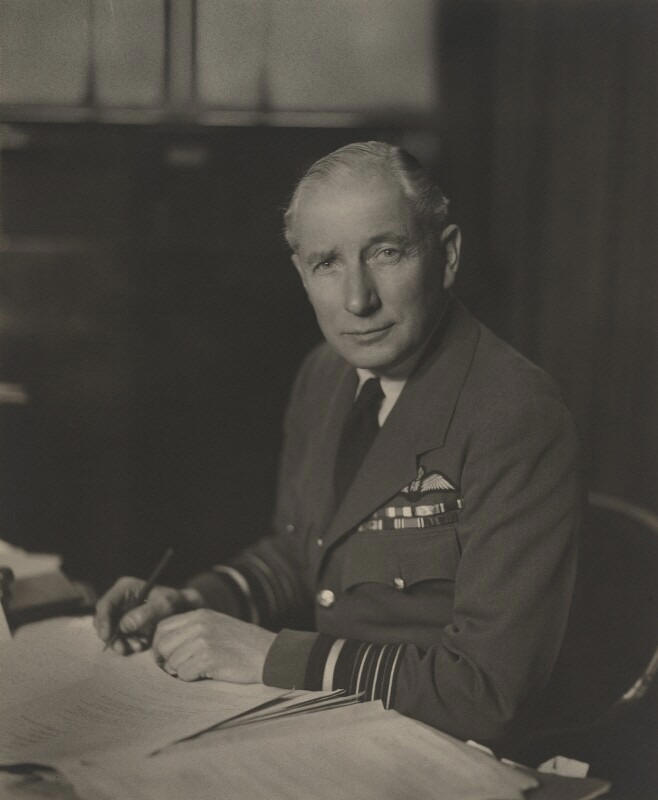
Sir Wilfrid Rhodes Freeman, 1st Bt
by Walter Stoneman
bromide print, November 1941
NPG x163243
© National Portrait Gallery, London
Air of Authority - A History of RAF Organisation
|
|
|
|
|
|
|
|
|
|
|
|
|
|
|
|
|
|
Air Chief Marshal Sir Wilfrid Freeman
 Wilfrid Rhodes
b:
18 Jul 1888
r: 19 Oct 1942
d: 15 May 1953
Wilfrid Rhodes
b:
18 Jul 1888
r: 19 Oct 1942
d: 15 May 1953
Baronet - 14 Jun 1945 (Conferred 24 Jul 1945), GCB - 20 Oct 1942 (KCB - 11 May 1937, CB - 1 Jan 1932), DSO - 23 Nov 1916, MC - 27 Mar 1915, MiD - 22 Jun 1915, MiD - 25 Sep 1916, MiD - 11 Dec 1917, LoH, C -17 Aug 1918, FRAeS.
For a list of foreign decoration abbreviations, click here
(Army):
- 2 Lt: 22 Feb 1908, Lt: 27 Mar 1912, (T) Capt: 17 Mar 1915,
Capt: 10 Jun 1915, (T) Maj: 27 Oct 1915, (T)
Lt Col: 5 Jul 1916,
(B) Maj: 1 Jan 1917,
(RAF): - Lt Col: 1 Apr 1918, Col: 22 Apr 1918, Wg Cdr: 1 Aug 1919 [1 Apr 1918], Gp Capt: 1 Jan 1923, A/Cdre: 1 Jul 1929, AVM: 1 Jul 1933, AM: 1 Jan 1937, (T) ACM: 27 May 1940, ACM: 14 Apr 1942 [27 May 1940].
Sir Wilfrid Rhodes Freeman, 1st Bt
by Walter Stoneman
bromide print, November 1941
NPG x163243
© National Portrait Gallery, London
xx xxx xxxx: Attended RMC Sandhurst.
22 Feb 1908: Officer, The Manchester Regiment
xx Jan 1914: Attended Central Flying School
28 Apr 1914:
Appointed to RFC Reserve.
28 Apr 1914: Pilot, No 2 Sqn RFC.
12-14 Sep 1914: Missing
xx Oct 1914: Pilot, No 9 Sqn. RFC
17
Mar 1915: Flight Commander, No
9 Sqn RFC.
6-9 Apr 1915: Admitted to hospital
16 May 1915: Returned to UK
xx
Jun 1915:
Instructor, Shoreham.
27 Oct 1915: Officer Commanding, No ? (Training) Sqn.
20
Jan 1916: Officer Commanding, No 14 Sqn RFC
5 Jul 1916: Officer Commanding, No 4 Training Wing
18 Jul 1916: Officer Commanding, No 7 Training Wing
22 Dec 1916: Returned to France
24 Dec 1916: Officer Commanding, 10th (Army) Wing RFC
9-23 Jan 1917: To HQ 1st Brigade on Temporary Duty
10-18 Mar 1917: To HQ 1st Brigade on Temporary Duty
11 Oct 1917: Officer Commanding, 9th (HQ) Wing RFC
6-14 Feb 1918: To England on Temporary Duty
24 Mar - 4 Apr 1918: Admitted to hospital
21 Apr 1918: Returned to UK
22
Apr 1918: Officer Commanding, No 2 (Training) Group
3 Jun 1918: Attended RN Staff College, Greenwich.
xx xxx 1919:
Holding post?, Air Pilotage
School (cadre)
1
Aug 1919:
Awarded Permanent Commission as a Lieutenant Colonel
5
Jun 1920: Officer Commanding, No 2 FTS,
Duxford.
1 Nov 1921:
Holding
post, Air Pilotage School (cadre) - pending formation of RAF Staff College
3 Jan 1922:
Directing Staff, RAF Staff College
22
Apr 1925: Commandant, Central Flying School
(Upavon and Wittering).
24
Jan 1927: Deputy Director of Operations and Intelligence.
27
Oct 1928: Officer Commanding, RAF Base Leuchars.
15
Oct 1929: Chief Staff Officer, HQ Inland Area
9
Oct 1930: Chief Staff Officer, HQ Iraq Command.
20
Nov 1930: AOC, Transjordan and Palestine.
22
Oct 1933: Supernumerary, RAF Depot.
12
Dec 1933: Commandant, RAF Staff College
1
Apr 1936: Air Member for Research and Development.
1
Aug 1938: Air Member for Development and Production.
5
Nov 1940: Vice-Chief of the Air Staff
19
Oct 1942 - xx Mar 1945:
Chief Executive , Ministry of Aircraft Production (Retired List)
 He
was educated at Rugby School before entering the RMC at Sandhurst and learnt to fly at a flying school in France in 1912, gaining Flying Certificate
No 1404 on 21 July 1913. Transferring to the RFC on
his return, he become one of it’s earliest members
On 12 September 1914, his aircraft began to seriously vibrate leaving him with
only one option, to force land behind enemy lines.
Having successfully managed this, he and his observer, Lt Dawes, set off
under cover of darkness to walk the eight miles back to the British lines, which
they accomplished in two days, including having to swim the River Aisne. However, on return to their squadron their euphoria at having
succeeded was dashed when their CO reprimanded them for flying together (both
were pilots) without instructions. In
March 1915 he was gazetted with one of the first MC's to be awarded to a member
of the RFC
He
was educated at Rugby School before entering the RMC at Sandhurst and learnt to fly at a flying school in France in 1912, gaining Flying Certificate
No 1404 on 21 July 1913. Transferring to the RFC on
his return, he become one of it’s earliest members
On 12 September 1914, his aircraft began to seriously vibrate leaving him with
only one option, to force land behind enemy lines.
Having successfully managed this, he and his observer, Lt Dawes, set off
under cover of darkness to walk the eight miles back to the British lines, which
they accomplished in two days, including having to swim the River Aisne. However, on return to their squadron their euphoria at having
succeeded was dashed when their CO reprimanded them for flying together (both
were pilots) without instructions. In
March 1915 he was gazetted with one of the first MC's to be awarded to a member
of the RFC
During
his four years as Air Member for Research and Development/Development and
Production, he was responsible for some of the most important decisions
regarding aircraft and equipment at a most critical period for the expanding
RAF. These included the pushing for
the development of four engined heavy bombers, resulting in the eventual
production of Stirlings, Halifaxes and Manchesters, the latter leading to
development of the excellent Lancaster. Another
project, which he sanctioned against great opposition, was the all wooden
Mosquito proposed by Geoffrey DeHavilland, which initially gained the nickname
of 'Freeman's Folly'. His tour of
duty as AMDP also covered the development of the eight gun fighters (Hurricane
and Spitfire), Radar and he gave valuable support to Frank Whittle's work on the
jet engine. Many of these
developments would have possibly floundered without his support and as a result
he provided a major contribution to the final Allied victory. During his tenure as VCAS, Freeman was sent out to the Middle
East to look into the problems being encountered in that theatre.
This was at the insistence of Churchill who really wanted Freeman to
replace Tedder as AOC in C, but after both Portal and Freeman threatened to
resign if Tedder was replaced, Churchill was forced to back down and leave
Tedder in post. Retiring he
was appointed to the post of Chief Executive at the Ministry of Aircraft
Production, Here he worked closely
with Lord Beaverbrook and he soon found that this had it's disadvantages leading
to a great deal of conflict between the two.
Following one particular disagreement with Beaverbrook, Freeman
approached Portal and requested to be allowed to return to the RAF
in any capacity whatever. Fortunately
the problem was sorted out and it was Beaverbrook who was finally moved with
Freeman remaining in his post until the end of the war.
Post war, Sir Wilfred Freeman went to work at Courthauld's where he
remained until his death in 1953.
Photograph © Crown Copyright
Citation for the award of the Military Cross
"Lieutenant W. R. Freeman, The Manchester Regiment and Royal Flying Corps.
For gallantry, ability, and very valuable work performed. Located the position of German batteries on 10th instant, and conveyed the information by wireless messages from his aeroplane to our Artillery, and, although his propeller and planes were pierced by the enemy's bullets, he remained aloft for more than five hours during the day."
(London Gazette - 27 March 1915)
This page was last updated on 16/03/25©
 J
M Freeman
J
M Freeman 