














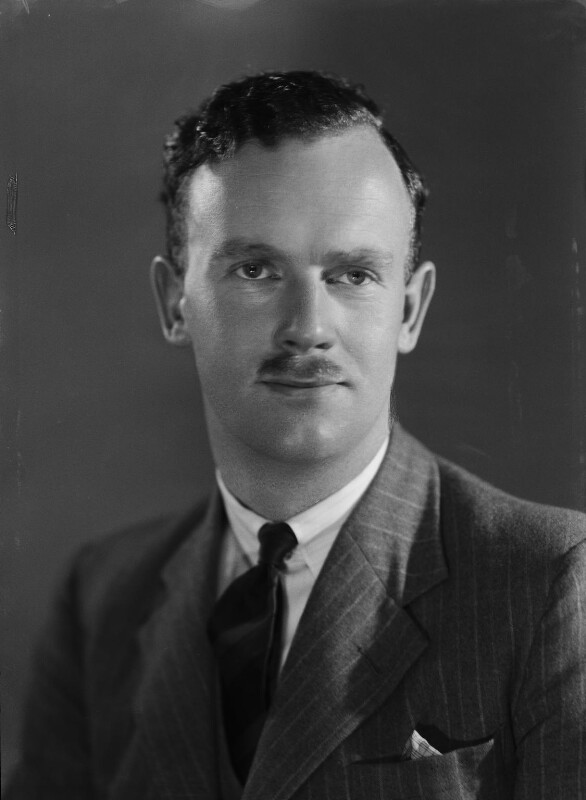
Frederick Fitzpatrick Rainsford
by Bassano Ltd
half-plate film negative, 14 November 1938
NPG x155916
Air of Authority - A History of RAF Organisation
|
|
|
|
|
|
|
|
|
|
|
|
|
|
|
|
|
|
 Frederick Fitzpatrick
b: 12 Dec 1909
r: 6 Apr 1962
d: 13 Feb 1999
Frederick Fitzpatrick
b: 12 Dec 1909
r: 6 Apr 1962
d: 13 Feb 1999
CBE
– 9 Jun 1949, DFC – 19 Oct 1943, MiD - 1 Jan 1941, BAgr.
(Spec Res): Plt Off (P): 17 Dec 1932, Plt Off: 8 Jan 1934, Fg Off: 16 Sep 1934.
(RAF): Plt
Off (P): 20 Jan 1936, Plt Off: 20
Jan 1937, Fg Off: 20 Jul 1937, Act
Flt Lt: 12 May 1939, Flt Lt:
20 Jul 1939,
Frederick Fitzpatrick Rainsford
by Bassano Ltd
half-plate film negative, 14 November 1938
NPG x155916
17 Dec 1932: Pilot, No 502 (Ulster) Special Reserve Sqn.
20 Jan 1936: Relinquishes his SR Commission on appointment to a Short Service Commission
20 Jan 1936:
Granted a Short Service Commission in the rank of Pilot Officer on
Probation.
20 Jan 1936: Pilot, Adjutant, No 215 Sqn.
xx xxx xxxx: Attended Long Navigation Course
xx xxx xxxx: Navigation Officer, No 215 Sqn
4 Nov 1939: Officer Commanding, 'A' Flight, No 215 Sqn
20 Jan 1940: Transferred to RAFO and called up for service (Gazetted 11 Jan 1944)
29 Jan 1940: Chief Ground Instructor, RAF Bassingbourn
8 Apr 1940: Chief Ground Instructor, No 11 OTU.
22 Feb 1941: Officer Commanding (acting), No 148 Sqn.
4 Mar 1941: Flight Commander, No 148 Sqn.
12 Mar 1941: Officer Commanding (Temporary), No 148 Sqn.
21 Jun 1941: Officer Commanding, No 148 Sqn.
25 Jun 1941: Flight Commander, No 148 Sqn.
24 Jul 1941: Officer Commanding, No 148 Sqn, wef 22 Jul 1941
xx xxx 1942: Officer Commanding, RAF Molesworth.
xx Apr 1942: Chief Instructor, No 29 OTU.
26 Sep 1942: Attended RAF Staff College, Bulstode.
xx Jan 1943: Staff Officer, HQ No 3 (Bomber) Group.
xx Jun 1943: Officer Commanding, No 115 Sqn.
xx Dec 1943: Staff Officer, HQ No 33 Base.
xx Jan 1945: Officer Commanding, RAF Gamston.
2 Feb 1945:
xx Jun 1945: Officer Commanding, No 105 (T)CU/No 1381 (T)CU.
9 May 1946: Accepted for appointment to an Extended Service Commission
25 May 1946: Air Staff - Training, HQ Transport Command.
xx Oct 1946: Resigned from RAF (Min of Civil Aviation).
7 Jul 1947: Deputy Director of Air Support and Transport Operations.
12 May 1947: Appointed to Permanent commission in the rank of Squadron Leader (retaining rank current at the time)
xx xxx 1947: Director of Air Support and Transport Operations.
xx Sep 1949: Directing Staff, RAF Staff College - Bracknell.
xx Aug 1951: Officer Commanding, RAF Lichfield.
27 Nov 1952: Group Captain - Organisation, HQ Far East Air Force.
26 Sep 1955: Officer Commanding., No 3 Recruit Training School, Padgate.
xx Dec 1956: Officer Commanding., RAF/WRAF Recruit Training School, Wilmslow.
xx Jul 1957: Vampire Flying Course, Worksop.
14 Nov 1957: Air Attaché, Athens.
15 Jun 1960: Directing Staff, RN Staff College, Greenwich.
Raised in Ireland, where his father was a senior officer in the Royal Irish Constabulary, he moved to Belfast when his father retired in 1922 due to the escalating troubles. Failing to gain Special Entry to the Royal Navy, he was persuaded by a distant cousin to join him in Kenya as a pupil farmer. Travelling out in 1929, he quickly settled down into the colonial life style. After two years, he decided to return to Britain in order to gain an Agricultural Degree with a view to returning to East Africa as an Agricultural Officer in the Colonial Service.
Enrolled at Queen's University, Belfast, he soon met up with two medical students who talked him into accompanying them to join No 502 (Ulster) Special Reserve Squadron. Not being particularly impressed by flying, he failed the subsequent medical and could have easily have taken his aeronautical career no further, but his Irish determination ensured that he improved his fitness, reapplying six months later and being accepted. As an Act he learnt to fly on Avro 504's but set something of a record, taking over 27 hours and nearly a year to go solo. However, having graduated from the Avro's he then flew the squadron's Virginias.
Graduating from Queen's Fred Rainsford gained a job on a pig farm setting up a record system but disenchanted with this and realising that a war was inevitable, he decided to apply for a Regular Commission which he received in March 1936. Posted to No 215 Squadron then flying Virginia Mk X's, but re-equipment with Ansons and Harrows soon took place. Staying with No 215 he moved to RAF Driffield and then Honington where the Squadron re-equipped with Wellingtons in 1939. 215 eventually moved to the Isle of Man (Jurby) where it was disbanded, the remnants including Fred Rainsford then moved to Bassingbourne to form No 11 OTU. Whilst there he occupied the posts of Adjutant, Flight Commander and Chief Ground Instructor.
Having attained the rank of Squadron Leader, he volunteered for service in the Middle East. Travelling out to Malta, he then flew a Wellington to El Adem in Libya and then onto Kabrit in Egypt. Taking command of No 148 Sqn, he reverted to Flight Commander on the arrival of a more experienced Wing Commander. Operating from advanced landing grounds in the desert No 148 carried out most of it's missions against Benghazi although raid were made on Greek Islands to assist the Greek campaign. Returning to Britain via the reverse 'Takoradi Route', he was offered a flight back from West Africa aboard a Liberator, but when mechanical troubles delayed it's return he travelled by ship. He later heard that the Liberator had eventually crashed into the Mourne Mountains with no survivors. Posted to command RAF Molesworth following a conversion course on the Whitley, within weeks he found himself at RAF North Luffenham as Chief Instructor on No 29 OTU, training crews for operations on Wellingtons. Attending a wartime Staff Course at Bulstrode he next served on the staff of HQ No 3 Group processing the orders from HQ Bomber Command to the operational squadrons.
Four months as a staff officer was followed by further command, this time of the only Lancaster Mk II squadron, No 115, at East Wretham in Norfolk. He soon found that operations over Germany differed dramatically from those in the Middle East. He was involved in operations against targets in Germany and Italy including Operation 'Gomorrah' on Hamberg and the Peenemunde Raid. December 1943 saw his tour as a Squadron Commander at an end when he was admitted to Ely Hospital with tonsillitis. In the New Year, he found himself once again serving as a staff officer, this time at HQ No 33 Base, RAF Waterbeach. Just before the end of the war, he took over as Station Commander at RAF Gamston, which was then home to No 30 OTU. On the disbandment of No 30 OTU, he found himself moved to Bramcote to command No 105 (Transport) CU, equipped with Dakotas. This Conversion Unit was redesignated No 1381 (T)CU and shortly afterwards moved to Desborough still with Fred Rainsford in command. Six months there and with the run down of the RAF resulted in his reversion to Wing Commander and a posting to HQ Transport Command.
With his future in the post-war RAF uncertain, he decided to resign his commission and took a post with the Ministry of Civil Aviation. In this post he was sent to Montreal as a British representative on the Provisional International Civil Aviation Organisation (forerunner of the current ICAO), serving as the secretary to the Medical Committee. Fortunately, just as this temporary post was coming to an end, he was offered a Permanent Commission in the RAF as a Squadron Leader. Promoted to Wing Commander prior to his first appointment, he found himself back at the Air Ministry as Deputy Director of Air Support and Transport Operations under Air Commodore David Atcherley. In this post, he found himself planning for the possibility of re-supplying the Berlin Garrison by air if need be, little knowing that the Russians would soon make this necessary.
With David Atcherley moving to command the CFE shortly after the Airlift started, Fred Rainsford moved into the post of Director and took on the responsibility of masterminding the Air Ministry's response to the Russian blockade. For his work during this phase of his career, he was awarded the CBE in the Birthday Honour's List of June 1949. Offered the chance of commanding a station in Germany or becoming a member of the Directing Staff at the Staff College, he choose the later to widen his experience. A further spell as a Station Commander followed, with his appointment as OC, No 6 Air Navigation School at Lichfield. However, a move overseas did come his way when he was appointed to the post of Group Captain - Organisation at HQ Far East Air Force. In this role he was responsible for works services and establishments within the extensive FEAF area and as a result he was able to travel from his base in Singapore to Ceylon, Japan, Korea and Australia as well as within the Malayan Federation. This appointment coincided with the Korean War and Operation 'Firedog'.
Returning to Britain again, found him for a short time in command of two Recruit Training Schools, the first at Padgate training National Service Airmen and the second at Wilmslow, at that time the only school training both RAF and WRAF recruits. A jet flying course on Vampires at Worksop preceded yet another overseas tour, this time as Air Attaché to Athens. Once again he entered a turbulent arena, this time as a result of the Greek Cypriot call for union with Greece (ENOSIS). However, during his tenure, the Cyprus situation was resolved and he was able to visit Greek Air Force stations, something his predecessor had been unable to do. He retired at his own request.
Citation
for the award of the Distinguished Flying Cross.
“Wing
Commander Frederick Fitzpatrick RAINSFORD (37507). Reserve of Air Force
Officers, No.115 Squadron.
This
officer has participated in a large number of sorties, many of them whilst
serving in the Middle East. More
recently he has taken part in attacks on various targets in Germany including
Dortmund, Wuppertal and Hamburg.
Wing Commander Rainsford's efforts have been characterised by outstanding
determination to achieve success and he has set an example worthy of high
praise.”
This entry was last updated on 12/01/26©
 R L Ragg
