|
|
|
|
|
|
|
|
|
|
|
|
|
|
|
|
|
|
Air of Authority - A History of RAF Organisation
|
|
|
|
|
|
|
|
|
|
|
|
|
|
|
|
|
|
Air
Chief Marshal Lord Dowding of Bentley Priory
 Hugh
Caswall Tremenheere
Hugh
Caswall Tremenheere
b:
27 Apr 1882
r: 1 Oct
1941/15 Jul 1942
d: 15 Feb 1970
Baron - 2 Jun 1943 (Conferred 9 Jul 1943), GCB - 8 Oct 1940 (KCB - 3 Jun 1933, CB - 2 Jan 1928), GCVO - 23 Jun 1937, CMG - 1 Jan 1919, MiD - 1 Jan 1916.
(Army):
- 2 Lt: 18 Aug 1900, Lt:
8 May 1902, Capt:
18 Aug 1913, (T)
Maj: 17 Mar 1915, Maj: 30
Dec 1915, (T) Lt Col: 1 Feb 1916, (T)
Col: 1 Jan 1917, (T)
Brig-Gen:
22 Jun 1917,
(B) Lt Col:
1 Jan 1918.
(RAF):
- (T) Brig-Gen [Lt Col]: 1
Apr 1918, Col: 1 Apr 1918, Gp
Capt: 1 Aug 1919, A/Cdre: 1 Jan
1922 [1 Aug 1919], AVM: 1 Jan 1929, AM: 1 Jan 1933, ACM: 1
Jan 1937.
Photograph (Left) © Crown Copyright
xx
Sep
1899: Attended RMA Woolwich.
18
Aug 1900: Garrison Artillery – Gibraltar, Ceylon, Hong Kong.
|
|
|
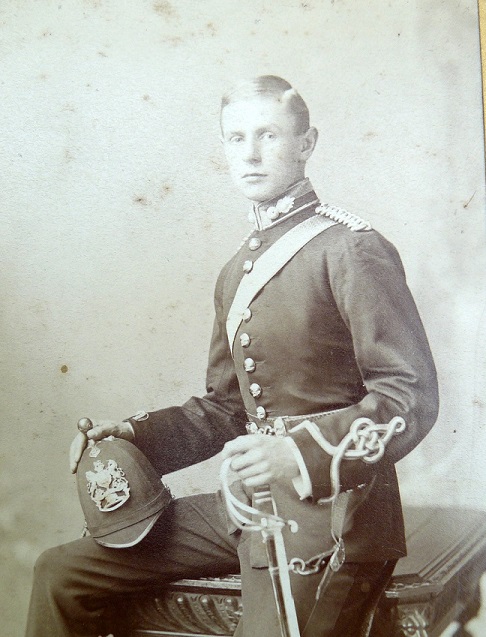
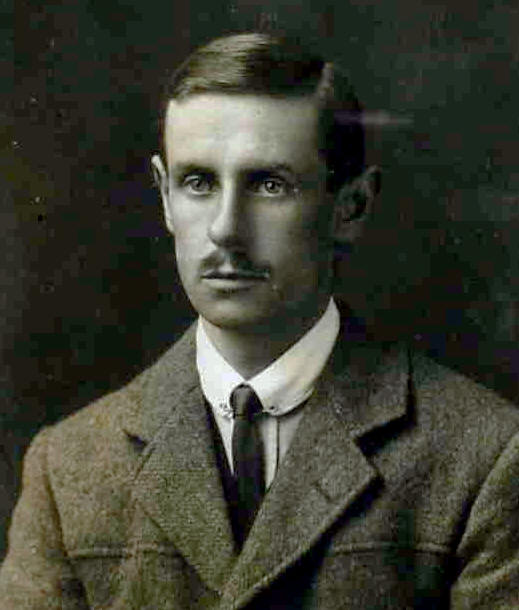
Hugh Dowding, aged 18, as a second lieutenant in the Royal Garrison Artillery, August 1900. Photo - Dowding Estate courtesy David Whiting (step-son)© |
xx
xxx 1904: No 7 Mountain Artillery Battery – NWF, India
xx xxx 1911: Preparing for Staff College
xx
Jan
1912: Attended Army Staff College.
xx
xxx 1913: Garrison Artillery - Isle of Wight
xx Jan 1914: U/T Pilot, Central Flying School
28 Apr 1914: Transferred to RFC Reserve.
xx
Aug 1914:
Commandant - Dover Assembly Point
xx
Aug 1914:
Pilot, No 7 Sqn RFC.
6
Oct 1914:
Pilot, No 6 Sqn RFC.
18
Nov 1914: GSO3, HQ RFC.
8
Dec 1914:
Flight Commander, No 9 Sqn RFC.
27 Jan 1915: Flight Commander, No 6 Sqn RFC.
4 Mar 1915: Officer i/c Wireless Flight, No 4 Sqn RFC.
17 Mar 1915: Officer Commanding No 9 Sqn/Wireless Experimental Establishment RFC.
23
Jul 1915:
Officer Commanding No 16 Sqn RFC (Various types)
1
Feb 1916:
Officer Commanding, 7th Wing RFC, Farnborough
22
Jun 1916:
Officer Commanding, 9th (HQ) Wing RFC.
1 Jan 1917: Officer Commanding, Southern Group Command.
5
Aug 1917: Brigadier-General Commanding, Southern Training Brigade
1
Apr 1918:
Brigadier-General (Administration), HQ No 4 Area.
8
May 1918:
Brigadier-General (Administration), HQ North-Eastern Area.
1
Jan 1919:
Brigadier-General (Administration) York, HQ North-Western Area.
1
Jun 1919:
Brigadier-General (Administration), HQ Northern Area.
|
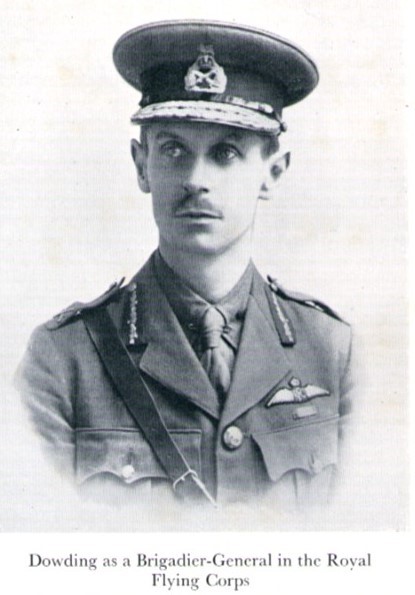
Photo - Dowding Estate courtesy David Whiting (step-son)© |
5 - 25 Apr 1919: Graded as Maj-Gen whilst Temporary GOC, HQ Northern Area.
1
Aug 1919:
Gp Capt: (Administration), HQ Northern Area.
1 Aug 1919: Re-seconded to RAF for further two years (gazetted 27 Apr 1920)
1 Sep 1919: Temporary AOC, Northern Area.
18
Oct 1919: Officer Commanding, No 16 Group
15
Feb 1920: Officer Commanding, No 1 Group
27
Feb 1922: Chief Staff Officer, Inland Area
19
Aug 1924: Chief Staff Officer, HQ Iraq Command.
27
May 1926: Director of Training
7
Sep 1929:
Tour of Inquiry/AOC, Transjordan and Palestine
28
Dec 1929: AOC, Fighting Area, Air Defence of Great Britain
1
Sep 1930:
Air Member for Supply and Research.
14
Jan 1935:
Air Member for Research and Development
1 Apr - 31 May 1936: Placed on half pay list, scale A.
14 Jul 1936: AOC in C, Fighter Command.
24 Feb 1937: Appointed Principal Air ADC to The King.
18
Dec 1940: Head of British Air Commission, Washington.
|
|
|
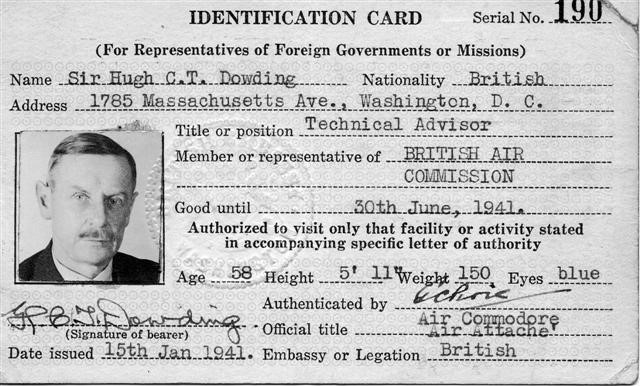
ID card issued to Dowding whilst on duty in the USA Photo - Dowding Estate courtesy David Whiting (step-son)© |
5 May 1941:
xx Nov 1941: Review of RAF Establishments in the UK.
|
|
|
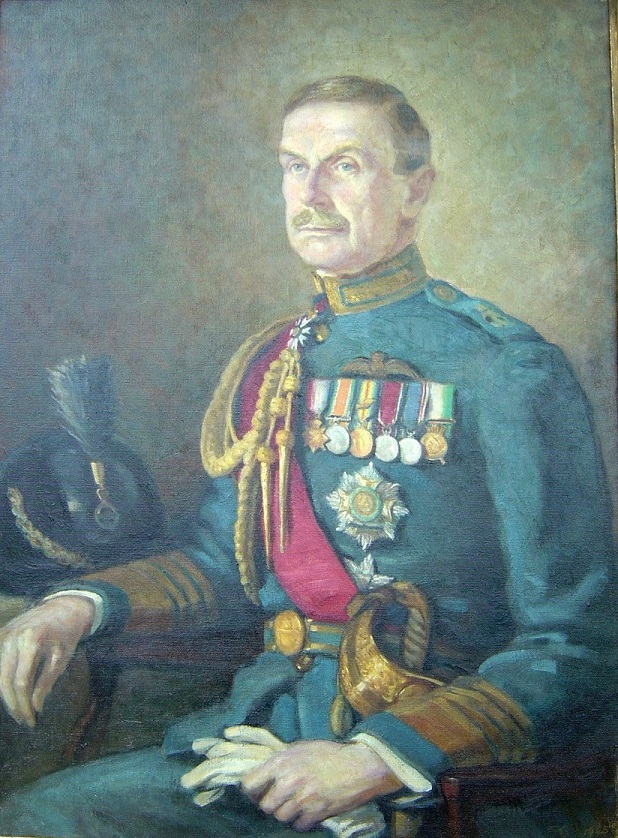
Air Chief Marshal The Lord Dowding of Bentley Priory, GCB, GCVO by Faith Kenworthy-Browne 1945. Photo - Dowding Estate courtesy David Whiting (step-son)© |
|
|
|
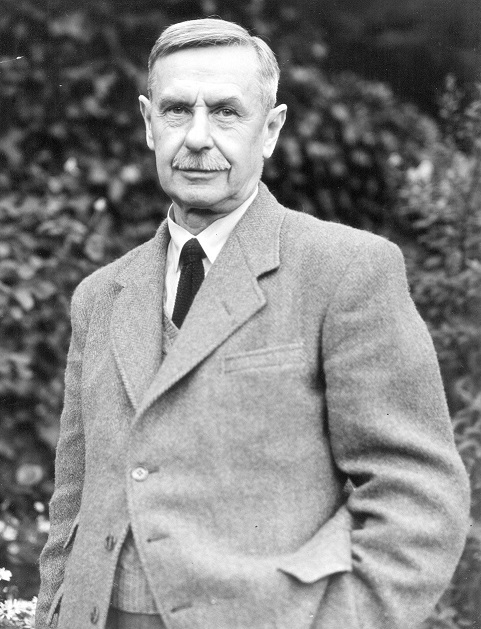
Post-war photograph of Lord Dowding Photo - Dowding Estate courtesy David Whiting (step-son)© |
|
|
|
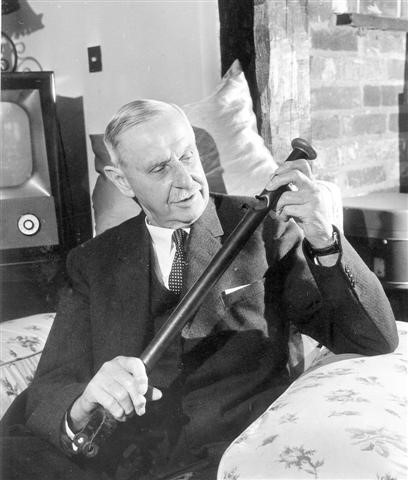
1960 Lord Dowding holding the control column of BE2 he was flying with 16 Squadron over enemy lines winter 1916 when a bullet went through and grazed his hand. Photo - Dowding Estate courtesy David Whiting (step-son)© |
Educated at his father's preparatory school at Moffat and then Winchester, after which he entered the Royal Military Academy at Woolwich. Failing to gain a commission in the Royal Engineers, he joined the Royal Garrison Artilliery.
He learnt to fly at the Vickers Flying School, Brooklands, gaining his RAeC Certificate (No 711 on 20 December 1913), on the day he passed out from Camberley, after 1 hour 40 minutes. At the Central Flying School his instructor was Capt. John Salmond. Having gained his 'Wings', he was added to the RFC Reserve List returning to his Garrison Artillery duties on the Isle of Wight. In 1929, following the escalation of trouble in the area, he was sent to Palestine to undertake an inquiry into the need and form of possible re-inforcements for the area.
On 28 January 1936 he was one of three officers representing the Air Council at the funeral of HM King George V.
As Air Member for Research and Development he was in a
position to oversee the development of the eight gun fighters (Hurricane and
Spitfire), but even more importantly his previous experience in wireless
experiments gave him an excellent insight into possibilities of it's use in the
detection of aircraft. He was able
to take these preparations to their logical conclusion when given command of the
newly formed Fighter Command in July 1936.
He immediately set about developing a system able to make best use of his
limited resources and it was this system as much as anything that ensured
success in 1940. He established the
coastal chain of radar stations (then known as RDF), but the success of radar
really lay in the reporting and control system he set up which allowed aircraft
to be placed in the right place at the right height in time to meet the threat.
During
the Battle of Britain his most difficult problem was the conflict between AVM
Leigh-Mallory and AVM Park over tactics in which he supported both Group
Commanders and saw that both sets of tactics had their advantages but that they
were not necessarily suitable in both situations. From 1938 Dowding was advised of five separate retirement
dates, but each one was rescinded
for various reasons, therefore, his replacement in November 1940 as AOC in C
Fighter Command, when flush with success in the Battle of Britain was seen as a
snub by many, although it had in fact been planned.
This entry was last updated on 07/10/26©
 W S Douglas