

by Bassano Ltd
bromide print
NPG x85397
bromide print
NPG x85397
© National Portrait Gallery, London
Air of Authority - A History of RAF Organisation
|
|
|
|
|
|
|
|
|
|
|
|
|
|
|
|
|
|
Marshal of the RAF Sir John Salmond
 John
Maitland
b: 17 July 1881
r: 1 Apr 1933
d: 16 Apr 1968
John
Maitland
b: 17 July 1881
r: 1 Apr 1933
d: 16 Apr 1968
GCB
- 3 Jun 1931 (KCB - 1 Jan 1919), CMG -
4 Jun 1917, CVO - 27 Aug 1918, DSO - 18 Feb 1915, Bar -
24 Mar 1915,
(Army):
- 2 Lt: 8
Jan 1901, (L) Lt: 14 Nov 1903, Lt: 5 Apr 1904, Capt: 26 Jun 1910, (T) Maj:
1 May 1914, (B)
Maj:
22 Jun 1914, Maj: 8 Jan1916, (T) Lt Col:
13 Apr 1915, (B)
Lt Col:
3 Jun 1916, (T) Brig-Gen:
1 Feb 1916, (T) Maj-Gen:
22 Jun 1917, (B) Col: 7 Dec 1917.
(RAF):
- Maj-Gen: 1
Apr 1918 [2 Apr 1918], AVM: 1 Aug
1919 [1 Apr 1918], AM: 2 Jun 1923 [1
Aug 1919], ACM: 1 Jan 1929, MRAF: 1 Jan 1933.
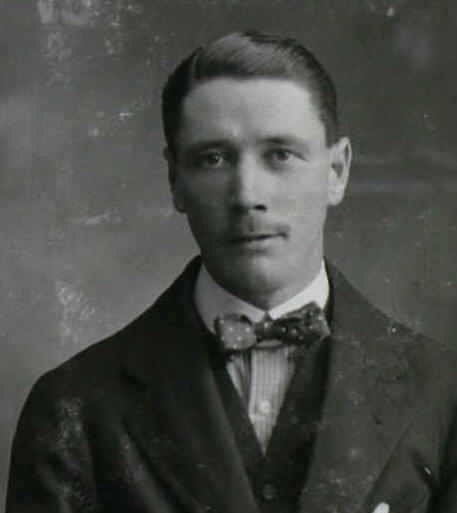
Photo (Far left) - taken from his RAeC Certificate
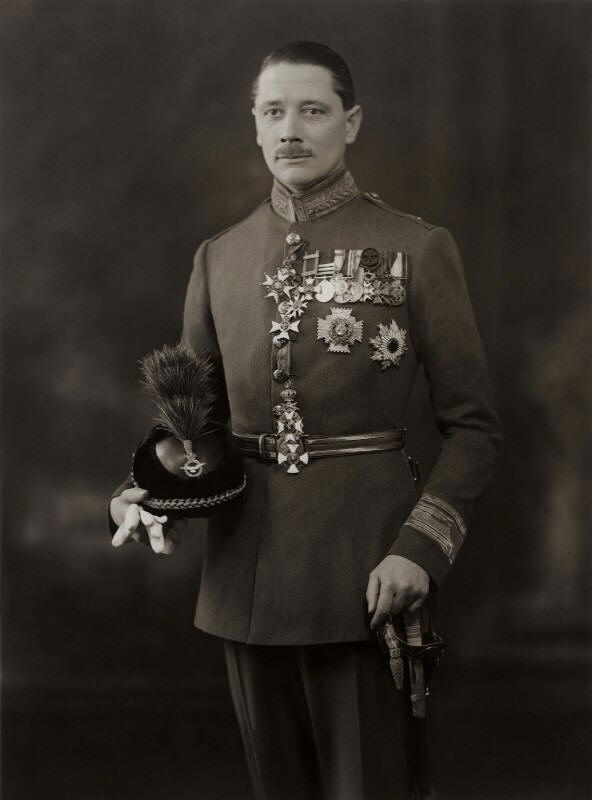
Photo (left) -
© National Portrait Gallery, London
xx
xxx xxxx: Attended RMC
Sandhurst.
8 Jan 1901: Officer, Unattached List
xx xxx 1901: Attended Musketry Course, Hythe
9 Mar 1901: Officer, King's Own Royal Lancashire Regiment
24 Jun 1901: Served in South Africa
9 Mar 1903: Served in UK
14 Nov 1903: Officer, West African Frontier Force
5 Apr 1904: Seconded for service under the Colonial Office
15 Jan 1905: Served in UK
xx xxx 1905: Attended School of Military Engineering
21 Jun 1905: From Supernumerary Lieutenant to Lieutenant
26 Nov 1906: Placed on temporary half pay due to ill health.
26 Apr 1907: Restored to establishment as Supernumerary Lieutenant of Territorial Battalion of Royal Lancashire Regiment. (originally gazetted as 4 May 1907)
17
Aug 1912: 'Wings' Course,
Central Flying School.
12 Nov 1912: 'D' Flight Commander, Central Flying School.
31 May 1913: Squadron Commander, Central Flying School.
1
May 1914: Officer Commanding,
No 7 Sqn (Sopwith Tabloid, BE8 – Farnborough)
12
Aug 1914: Officer Commanding,
No 3 Sqn. (Various types – Western Front)
13 Apr 1915: Officer Commanding, Administrative Wing, Farnborough.
18 Aug 1915: Re-embarked for France
19 Aug 1915: Officer
Commanding, Advanced Wing/2nd Wing RFC
1 Feb 1916: Appointed Brigade Commander
10 Feb 1916: Posted to II Brigade RFC
15 Feb 1916: Returned to Home Establishment
16
Feb 1916: Brigadier-General
Commanding, V Brigade RFC
9
Mar 1916: Brigadier-General
Commanding, VI Brigade RFC
xx
Jul 1916:
Brigadier-General Commanding, Training Brigade RFC
xx
Aug 1917:
GOC, Training
Division
18
Oct 1917: Director-General
of Military Aeronautics, War Office.
18
Jan 1918: GOC, RFC in the
Field.
6-11 Feb 1918: On Special duty
1
Apr 1918:
GOC, RAF in the
Field.
28-30 Apr 1918: Temporary duty in England
11-12 May 1918: Temporary duty in England
9-10 May 1918: Temporary duty in Paris
24-26 May 1918: Temporary duty in England
30-31 May 1918: Temporary duty in Paris
13-15 Jun 1918: Temporary duty in England
2-4 Jul 1918: Temporary duty in England
6-9 Jul 1918: Temporary duty in England
24-25 Jul 1918: Temporary duty in Paris
25-27 Sep 1918: Temporary duty in England
20-22 Nov 1918: Temporary duty in England
7 May 1919: Officer Commanding, HQ Rhine.
9 Jul 1919: Relinguished command of HQ Rhine (proceeded on leave)
22 Jul 1919: Returned to Home Establishment
1 Aug 1919: Resigned his commission in the Royal Lancashire Regiment on appointment to a Permanent Commission in the RAF.
1 Aug 1919: Awarded Permanent Commission as a Major-General
|
|
|
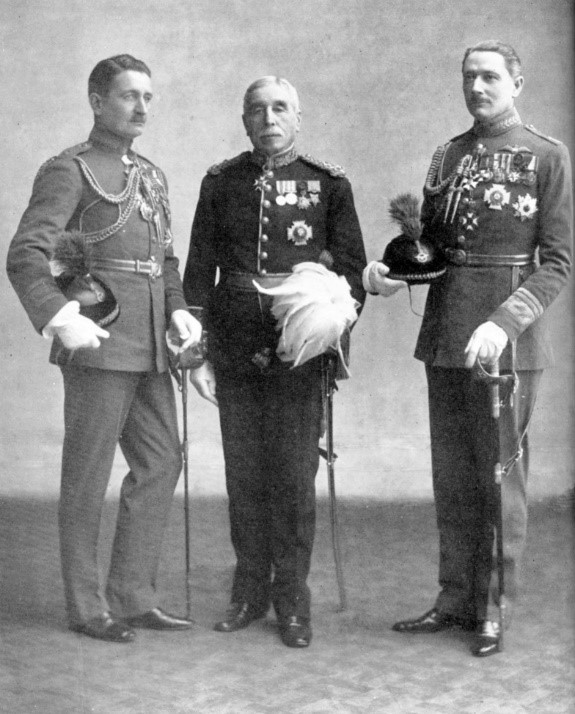
Major General Sir William Salmond with his two sons, Sir Geoffrey and Sir John |
|
|
|
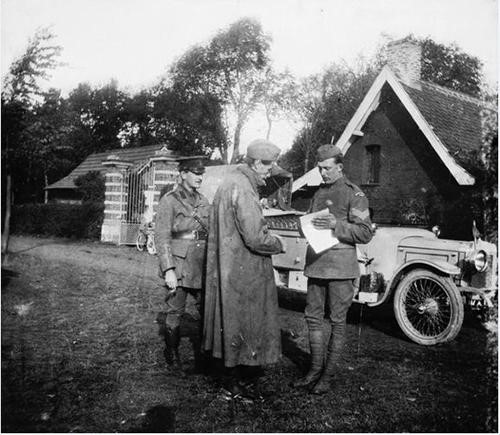
John Salmond in Trench Coat handing documents ( reconnaissance report) in with Geoff standing behind him. Photos courtesy Gp Capt D Baker (Sir Geoffrey's Great-Nephew) |
19
Aug 1919: AOC, South-Eastern
Area?
15
Sep 1919: AOC, Southern Area.
1
Apr 1920: AOC, Inland
Area.
26
May 1922: On Special Duty in India.
1 Oct 1922: GOC/AOC, Iraq Command
9 Oct 1924: Placed on half pay list, Scale A.
1
Jan 1925: AOC in C,
Air Defence of Great Britain.
26
May 1928: On loan to Australian
Government.
1
Jan 1929: Air
Member for Personnel
1
Jan 1930: Chief of
the Air Staff
1 Apr 1933: Relinquished his appointment as CAS and placed on half pay.
3 Apr 1933: Restored to full pay as an additional (temporary) member of the Air Council.
22 May 1933: Relinquished his appointment as an additional (temporary) member of the Air Council.
xx Dec 1939: Director of Armament Production
xx Oct 1941: Director-General of Aircraft Safety
John Salmond and his elder brother, Geoffrey, would
become the only brothers to both hold the post of Chief of the Air Staff and
although John was the youngest, he would lead the promotion race between them
throughout their careers. He was
educated at Wellington before entering the RMC at Sandhurst, but finding
the life of an infantry officer on garrison duty somewhat lacking he decided to
learn to fly. Gaining RAeC
Certificate No 272 on 13 August 1912, he then joined the first course at the CFS
where on graduating he was immediately appointed to the staff as an instructor.
This was followed by a posting to Farnborough where he was involved in
some early test flying, particularly of the SE4.
An incident during his command of No 3, showed his level of compassion.
When the pilot and a number of others were killed when a bomb exploded
whilst being loaded onto one of his aircraft, he immediately cleared the
area and insisted on removing the debris himself.
In August
1917 he was appointed to a seat on the Army Council as Director-General of
Military Aeronautics and in October he joined the newly created Air Council in
the same post. However, with the forthcoming formation of the RAF and the
appointment of Trenchard as CAS, Salmond returned to France to replace Trenchard
as GOC of the RFC in France. Originally
intending to leave the RAF and enter civil aviation, Trenchard returned to the
post of CAS just in time to convince Salmond that he should Remain in the
post-war RAF. In 1922, John
Salmond travelled to India to assess the air situation following complaints from
RAF personnel stationed there. Unfortunately,
although many of the problems faced by the RAF in India were obvious, the
solutions were not. The RAF in
India was actually funded by the Indian Government and not from the UK and so
although his recommendations were accepted many of them were slow in
materialising.
Instead
of returning home he was sent to Iraq where he became the first RAF officer to
be given command of all British Forces, both land and air, in a particular area.
This resulted from Trenchard's suggestion that air control of areas such
as Iraq could be cheaper than conventional land forces. As a result of his success in completing operations against
Sheikh Mahmoud in 1923, the Prime Minister authorised his immediate promotion
to Air Marshal.
Returning to the UK, he became the first AOC in C of
the newly independent Air Defence of Great Britain, which was to administer the
fighter and bomber elements of the RAF, leaving Inland Area responsible for the
non-operational aspects including training and for some reason Army
Co-operation. During 1928, he was asked by the Governments of both
Australia and New Zealand to visit their countries and advise them on the future
development of their Air Forces. As
CAS, Salmond successfully built on the foundations laid by Trenchard and
continued the fight to maintain the RAF's independence from the others two
services. Resigning in April 1933
to be replaced by his elder brother, Sir Geoffrey, he found himself in the
unenviable position of having to temporarily re-occupy the post owing to the
death of his brother whilst in office.
Finally handing over to Sir Edward Ellington in 1934,
he continued to take an active interest in the RAF and remained involved
wherever possible.
At the start of World War Two he accepted the
appointment of Director of Armament Production at the Ministry of Aircraft
Production. He was also asked to chair a number of committees including the
Night Defence Committee in 1940. Not
always in agreement with the Minister of Aircraft Production, Lord Beaverbrook
he resigned in 1941 but was almost immediately asked by Portal (CAS) to become
Director-General of Flying Control and Air Sea Rescue.
He finally retired due to ill health in 1943, but continued to take an
active interest in the fortunes of the RAF until his death, being made a Freeman
of the City of London in 1957.
This entry was last updated on 24/08/26©
 C J R Salmon