|
|
|
|
|
|
|
|
|
|
|
|
|
|
|
|
|
|
Air of Authority - A History of RAF Organisation
|
|
|
|
|
|
|
|
|
|
|
|
|
|
|
|
|
|
Air Commodore P Burnett
Patrick b: 13 Dec 1914 r: 13 Nov 1960 d: 27 Mar 2004
DSO
– 22 Oct 1943, DFC – 10 Sep 1943, MiD - 14 Jan 1944.
Act
Plt Off (P):
23 Sep/3 Dec 1936?, Plt Off: 23 Sep
1937, Fg Off: 23 Mar 1939,
Flt Lt (WS): 13 Sep 1940?, (T) Sqn Ldr: 1 Dec 1941, Act Wg
Cdr: 8 Sep 1942?, Sqn Ldr (WS): 8
Mar 1943, Sqn Ldr: 26 Mar 1946 [1 Sep
1945], Wg Cdr: 1 Jul 1947,
Gp Capt: 1 Jul 1954, Act A/Cdre:
13 Nov 1959?, A/Cdre: Retained.
19
Dec 1936:
U/T Pilot, No 4 FTS.
xx xxx 1937:
QFI, No 4 FTS
9 Jan 1939: Pilot, No 211 Sqn.
20 Jan 1939: Adjutant No 211 Sqn
19 Aug 1939: Pilot, No 211 Sqn
xx Aug 1939 - 4 Jan 1940: Attached, Blenheim Delivery Flight
4 Jan 1940: Officer Commanding, 'B' Flight, No 211 Sqn.
21 Mar 1940: Adjutant, No 211 Sqn.
xx xxx 1941: Instructor, No 70 OTU (Ismailia & Nakuru)
xx xxx 1942: Attended No 25 OTU
9 Jul 1942: Flight Commander, No 44 Sqn.
8 Dec 1942: Air Staff, HQ No 5 Group.
xx xxx xxxx: Attended Army Staff College.
12
Apr 1943:
Officer Commanding, No 9 Sqn.
14
Nov 1943:
23 Nov 1943: Temporary duty as Commandant, Air Crew School, RAF Scampton
5
Dec 1943:
|
|
|
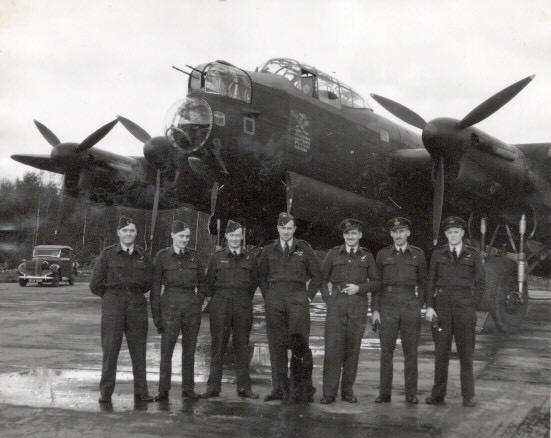
Wg Cdr Pat Burnett and his crew - Scampton 1944 Photo courtesy - John Ellerton |
3 Aug 1944: Posted to HQ Bomber Command
xx xxx 1944: Senior Operations Officer, No 55 Base, East Kirkby
13 Dec 1944: Attached, No 54 Base pending posting
27-28 Dec 1944: Detached to Hatfield on temporary duty
2 - 4 Jan 1945: Detached to Air Ministry and Stanmore on temporary duty
9 Jan 1945: Senior Operations Officer, No 54 Base, Coningsby.
1-3 May 1945: Attended Senior Officers' Radar Course, No 8 Radio School
8 Aug 1945: Air Staff, HQ No 5 Group
18
Dec 1945: Staff, Directorate of Personnel (II).
26 Mar
1946: Appointed to a
Permanent Commission in the rank of Squadron Leader
(retaining rank current at the time)
xx xxx xxxx: CFI, No 202 AFS, Finningley
1 Oct 1947: Tested and awarded the category 'B' as a Flying Instructor
xx xxx 1949: CFI, No 203 AFS, Driffield.
28
Nov 1950: Air Attaché, Stockholm.
xx Jun 1954: Officer Commanding, Officer Cadet Training Unit/RAF Jurby.
1 Apr 1957: Deputy Director, Directorate of Intelligence
13
Nov 1959: Director of Intelligence (B).
His father was one of five brothers, who ran an engineering firm in Doncaster, specialising in rolling stock for railways. He was educated at Oakham School and joined the RAF on a short service commission in 1936, being sent to Egypt to undertake his flying training. On completion of his training, he was retained by the school and became an instructor. He eventually joined his first squadron, No 211, which was then flying the Hawker Hind, although shortly after he arrived the squadron began to convert to the Blenheim. From June 1940 until early 1941, he undertook many operations against targets in Italian held areas of North Africa, but he was then taken off operations and became an instructor, again, this time training Blenheim crews.
In 1942 he returned to Britain and was posted as a flight commander on No 44 (Rhodesia) Squadron at Waddington, which had been the first to equipped with the Avro Lancaster. Amongst the operations in which he took part was the daylight raid against the armaments factory at Le Creusot in France on 17 October, which was carried out from 6,000 ft in order to minimise civilian casualties. He also took part in raids against Milan, Turin and Genoa in Italy and targets in the Baltic as well as the usual German targets.
Rested from operations at the end of 1942, he joined the air staff at HQ No 5 Group and six months later he was given command of No 9 Squadron at Bardney. In September 1943, he carried out a remarkable feat of airmanship after his aircraft had been attacked by a night fighter and was awarded an immediate DSO (see below). By the time he was rested from operations, he had completed 45 missions in Bomber Command in addition to the numerous missions carried out in North Africa. After attending the Army Staff College, he became the senior operations officer at Coningsby and then East Kirkby, still managing to undertake missions to repatriate PoWs at the end of the war.
He accepted a permanent commission in 1945 and served at the Air Ministry until appointed Chief Flying Instructor at No 202 Advanced Flying School, at Finningley, near his birth place of Doncaster in Yorkshire, training multi-engined crews on the Wellington. In 1949, he moved to Driffield, also in Yorkshire, as CFI of No 203 Advanced Flying School, tasked with training pilots on jets using Meteors. 1950 saw him appointed Air Attaché in Stockholm, followed by command of the Officer Cadet Training Unit at Jurby on the Isle of Man. His final appointment saw him back at the Air Ministry as a Director of Intelligence. In retirement, he went back to his roots and spent a further 15 years in light engineering.
“Acting Wing Commander Patrick BURNETT, D.F.C. (39252), Reserve of Air
Force Officers, No 9 Squadron.
Wing Commander Burnett is an ideal leader, whose untiring efforts and
personal example have been reflected in the high standard of operational
efficiency of the squadron he commands. He
has taken part in many sorties against important enemy targets and throughout
has displayed great skill and tenacity. On one occasion in September, 1943,when nearing base, on the
return flight from Hanover, his aircraft was damaged by machine gun fire from
any enemy fighter. Two engines were
put out of action but the airfield was reached.
When coming in to land, a third engine failed but, in spite of this, Wing
Commander Burnett effected a safe landing without the aid of the flaps which had
also been damaged. His masterly
effort merited high praise.”
(London Gazette – 22 October 1943)
This entry was last updated on 07/08/26©
 C S Burnett