














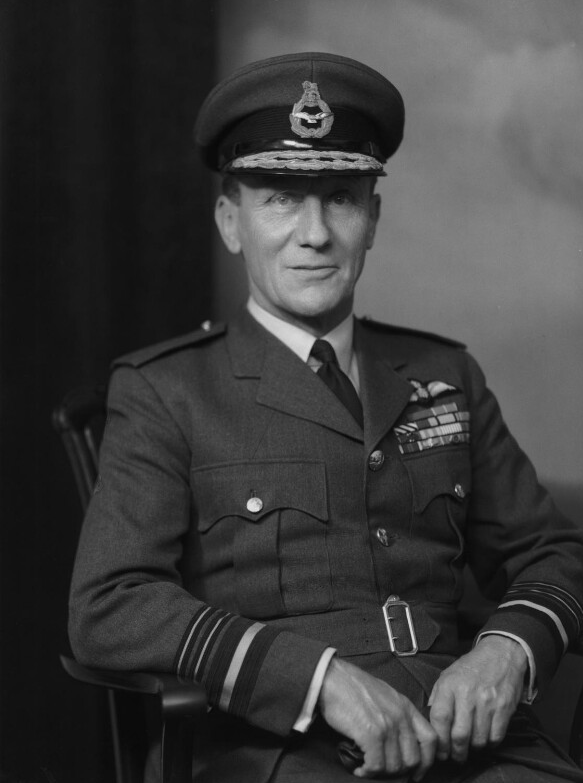
Photo (right) Sir Denis Hensley Fulton Barnett
by Elliott & Fry
quarter-plate negative, 1962
NPG x82683
Air of Authority - A History of RAF Organisation
|
|
|
|
|
|
|
|
|
|
|
|
|
|
|
|
|
|
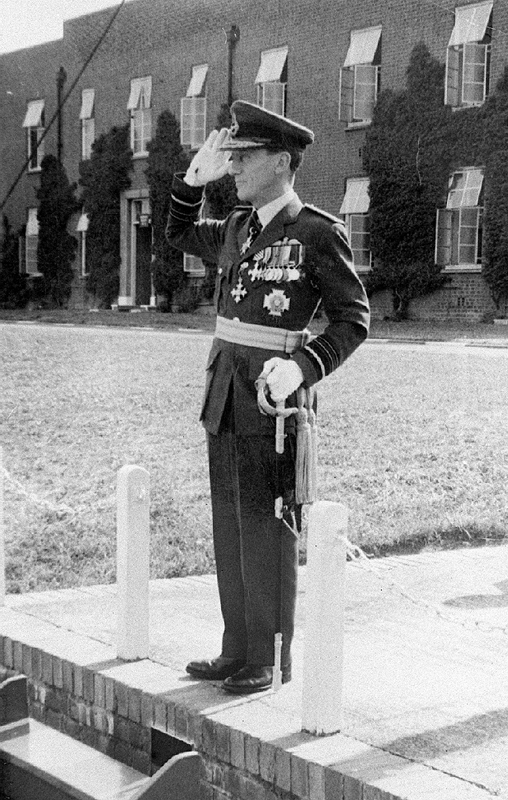
Air Chief Marshal Sir Denis Barnett (05167)
 Denis
Hensley Fulton
Denis
Hensley Fulton
b: 11 Feb 1906
r: 27 Nov 1964
d:
GCB - 13 Jun 1964 (KCB - 13 Jun
1957, CB -
2 Jan 1956), CBE -
1 Jan
1945, DFC - 24 Dec 1940,
(RAFO - Class AA):
Plt
Off (P) : 15 Aug 1927,
Photo (right) Sir Denis Hensley Fulton Barnett
by Elliott & Fry
quarter-plate negative, 1962
NPG x82683
Photo (left) ©Crown Copyright
xx Oct 1926: Member, Cambridge University Air Sqn
15 Aug 1927: Officer, RAFO
20 Aug 1928: Authorised to wear 'Wings' whilst serving in the RAFO
5 Oct 1929: Relinquished his RAFO commission on being appointed to a Permanent Commission in the RAF
5
Oct 1929:
U/T Pilot, No 5 FTS.
28 Feb 1930: Authorised to wear Flying Badge Certs 'B' and 'C'
24 Apr 1930: Awarded a Distinguished Pass on completion of flying training.
4
Mar 1930:
Pilot, No 13 Sqn.
7
Oct 1930:
Adjutant, No 13 Sqn.
1
Jan 1932:
Pilot, No 13 Sqn.
2 Feb - 16 Apr 1932: Attended Instructors' Course, CFS (categorised 'B')
17
Apr 1932: Flying
Instructor, No 5 FTS.
8 Jun - 24 Jul 1932: Attached for temporary duty as Flying Instructor, Cambridge University Air Sqn
2
Sep 1932:
Flying
Instructor, Station Flight - RAF Duxford.
2 - 27 Sep 1932: Attached, No 5 FTS
9 - 17 Jan 1933: Attached, Home Aircraft Depot
26 May 1933: Re-categorised from Instructor 'B' to 'A2'
22 Aug 1933: Flying Instructor, CFS
19 Nov 1934: Flying Instructor, Cambridge University Air Sqn
11
Sep 1935:
Flying Instructor, CFS.
23 Nov - 23 Dec 1936: Attended Anti-Gas Course, Small Arms School
2 Feb 1937: Re-categorised from Instructor 'A2' to 'A1'
11 Feb 1937: Adjutant, No 84 Sqn
15
Mar 1937: Supernumerary, Communications Flight - Iraq.
30
Mar 1937: Officer
Commanding, Communications Flight - Iraq.
8
Apr 1938: Supernumerary, No 84 Sqn.
14
Apr 1938: Officer Commanding, No 84 Sqn.
21
Nov 1938: Supernumerary, No 1 RAF Depot.
(Leave: 13 Dec 1938 -
3
Jun 1940:
Officer Commanding, No 40 Sqn.
24
Dec 1940:
7 Apr 1941: Operations Room Staff, HQ Bomber Command.
9
May 1942:
Supernumerary, RAF Swanton Morley.
11
May 1942: Officer Commanding, RAF Swanton Morley.
14 Jun 1943: Administrative Plans, Tactical Air Force HQ
3 Sep 1943: Organisation Policy, Tactical Air Force HQ
8 May 1944: Air Staff - Strategic Bombing, HQ Bomber Command
30 Oct 1944: Supernumerary, Air Ministry Unit (Directorate of Bomber Operations)
16
Jan 1945:
Deputy SASO, HQ Bomber Command.
27
Jun 1945:
Director of Bomber Operations.
1 Jan 1946:
Director of Operations.
22 Jun 1946: Supernumerary, Air Ministry Unit (pending posting)
25
Jul 1946:
Supernumerary, AHQ India.
1 Aug 1946:
Supernumerary, AHQ India.
15 Aug 1947: Air Staff Plans, AHQ (Supreme) India (SDL 450)
3 Nov 1947: Supernumerary, Mauripur, AHQ (Supreme) India (SDL 450)
10 Nov 1947: Officer Commanding, Mauripur, AHQ (Supreme) India (SDL 450)
1 Jan 1948: Officer Commanding, Mauripur Staging Post
28 Feb 1948: Supernumerary, Mauripur Staging Post
29 Feb 1948: Supernumerary, No 5 PDC (Deplaned: 2 Mar 1948, Disembarkation leave: 4 - 29 Mar 1948)
30 Mar 1948:
Attended No 3 Course, Joint Services Staff College.
11 Oct 1948: Supernumerary, Air Ministry Unit
11 - 23 Oct 1948: Attached Empire Flying School, Hullavington for Refresher Flying Course
24 Oct 1948:
Supernumerary, Central Bomber Establishment.
7 Nov 1948:
Gp Capt - Tactics, Central Bomber Establishment.
28 Mar 1949: Appointed ADC to the King.
31 Mar 1949:
Commandant, Central Bomber Establishment, RAF Marham.
14 Apr 1949: Commandant, Central Bomber Establishment, RAF Lindholme
17 Oct 1949: Temporary duty, Air Ministry Unit
25 Oct 1949: Director of Operations
1 Jan 1950: Relinquished appointment of ADC to the King.
21
Dec 1950: Director of Operations (1)
20 Dec 1951: Supernumerary, Air Ministry Unit, pending posting to course
31 Dec 1951 - 4 Jan 1952: Attached, Director Staff Training (briefing prior to IDC course)
5 Jan 1952:
Attended Imperial Defence College.
31 Jul 1952:
Supernumerary, Air
Ministry Unit
1 Oct 1952: Attached, Ministry of Defence for briefing prior to posting to Japan
15 Oct 1952: Supernumerary,
Air Ministry Unit
29 Oct 1952: Senior
British Liaison Officer to General Clark's HQ, Tokyo.
15 Mar 1954: Supernumerary,
Air Ministry Unit
17 May 1954: Attended Refresher Flying Course, RAF Flying College, Manby
29
Jun 1954:
Supernumerary, No 205 Group.
30
Jun 1954:
AOC, No 205 Group.
5 Mar 1956: Supernumerary, No 5 PDC (Deplaned: 7 Mar 1956, Leave: 8 Mar - 14 Apr 1956)
1 May 1956:
Commandant, RAF Staff College, Bracknell
1
Aug 1956:
Air Secretary
3 Aug 1956:
Air Task Force Commander, Operation 'Muskateer', Suez
23 Dec 1956
Air Secretary
14 - 25 Jan 1957: Attended Refresher Flying Course, RAF Flying College, Manby
1 - 8 Jan 1958: Attended Canberra Conversion Course, No 231 OCU
1
May 1959:
Supernumerary, Transport Command
16
May 1959: AOC in C, Transport Command
30 Apr 1962:
Supernumerary, Transport Command
16
Jul 1962:
AOC in C, Near East Air Force/Commander British Forces - Cyprus
16
Jul 1962:
The Administrator, Sovereign Base Areas - Cyprus
25 Sep 1964: RAF HQ Unit (Debriefing)
2 Oct 1964: RAF HQ Unit (Terminal Leave)
A
New Zealander, he joined the RAFO whilst at Cambridge, being awarded a permanent
commission in the RAF on completion of his degree.
In 1935, he was sent to the USA to study instructional methods used by
the American services.
As
AOC, No 205 Group, the task fell to him
of supervising the move of the RAF from Egypt to it's new bases in Cyprus
and remained in Egypt whilst the AOC in C established the new HQ in Cyprus,
eventually moving to the new HQ himself in October 1955.
However, his tour in the Mediterranean ended in 1956 and he returned to
the Britain to command the RAF Staff College.
1956 saw the gradual increase in tension between Britain. France and
Egypt following the latter's nationalization of the Suez Canal.
When this tension escalated to the point of armed conflict, he found
himself appointed to command of the air task force to be involved in the Suez
campaign, Operation Musketeer.
His immediate staff was selected from officers then attending the
Imperial Defence College where much of the early planning for this operation
took place.
His selection and the appointment of a planning staff divorced from the
existing Middle East command structure whilst not a popular move with the
resident Middle Eastern commanders (ACM Sir Hubert Patch and AVM W J Crisham)
was logical in that
Denis Barnett had more recent experience of operations and the situation
in Egypt than any other serving Air Officer.
The air task force was allocated he role of bombing the Egyptian
airfields in order to achieve the required air superiority.
He ordered operations to commence at 16:15 hours on 31 Oct 1956 and by 2
November he considered the Egyptian Air Force to have been eliminated as an
effective fighting force, a view which was later confirmed by the Bomber Command
Operational Research Branch.
From
1965 he was the Member for Weapons Research and Development on the Atomic Energy
Authority, a post he held until 1972.
This entry was last updated on 29/08/26©
 L K Barnes
